
Curcumin
Curcumin
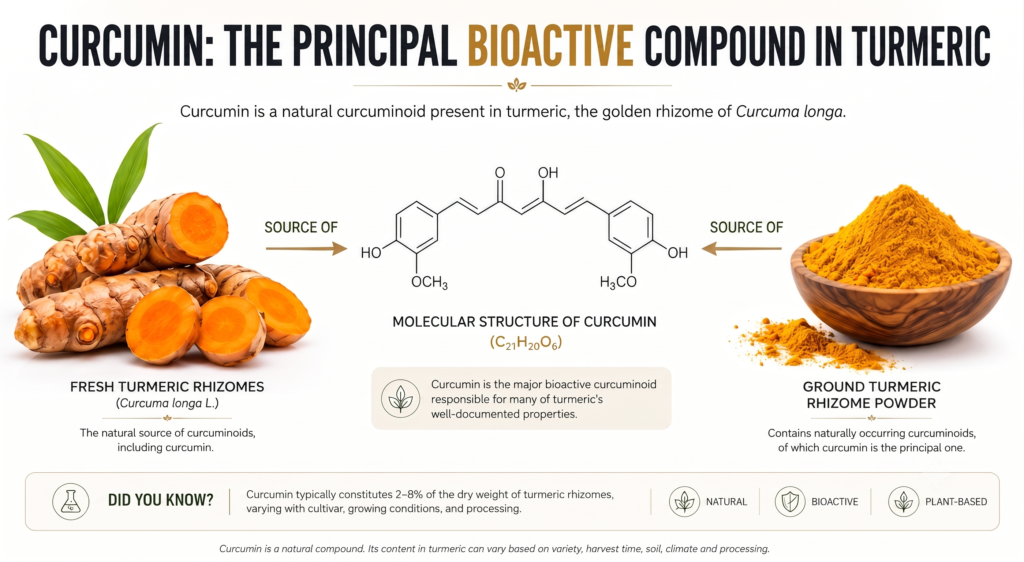
Occurrence in Turmeric
Chemical Structure
Curcumin consists of:
Two aromatic phenolic rings
Two methoxy groups
A seven-carbon conjugated linker
A β-diketone functional group
The molecule exists in equilibrium between keto and enol forms. The keto form predominates under acidic and neutral conditions, whereas the enol form becomes more stable under alkaline conditions. This tautomerism contributes to many of curcumin's chemical and antioxidant properties. [2]
![Chemical structure of curcumin and its essential functional moieties. [ref: https://www.researchgate.net/figure/Chemical-structure-of-curcumin-and-its-essential-functional-moieties_fig4_266387551]](https://www.researchgate.net/profile/Chanin-Nantasenamat-2/publication/266387551/figure/fig4/AS:392255329325059@1470532366158/Chemical-structure-of-curcumin-and-its-essential-functional-moieties.png)
Physical Properties
Natural Function in Turmeric
Although not fully understood, curcumin is believed to serve several ecological roles within the turmeric plant, including:
Protection against microbial infection
Defence against herbivores
Reduction of oxidative stress
Protection from ultraviolet radiation
Contribution to pigmentation
These functions are thought to improve the plant's survival under environmental stress.
Biological Activities
Experimental studies have reported that curcumin exhibits numerous biological activities.
These include:
Antioxidant
Anti-inflammatory
Antimicrobial
Antifungal
Antiviral
Antiparasitic
Hepatoprotective
Neuroprotective
Cardioprotective
Anticancer (experimental)
Wound-healing support
Most of these observations originate from laboratory experiments and animal studies. Human clinical evidence varies considerably depending on disease, dosage, formulation, and study design. [4]
Mechanisms of Action
Curcumin has been shown to interact with numerous molecular targets, including:
NF-κB signalling pathway
COX-2 enzyme
LOX pathway
TNF-α
IL-1β
IL-6
Reactive oxygen species (ROS)
Various protein kinases
Transcription factors
Growth factors
Its broad molecular interactions explain why curcumin has been investigated across many disease models.
Bioavailability
One of the greatest challenges associated with curcumin is its poor oral bioavailability.
Contributing factors include:
Low water solubility
Poor intestinal absorption
Rapid metabolism
Rapid systemic elimination
To overcome these limitations, researchers have developed:
Liposomal curcumin
Nanoparticle formulations
Micellar systems
Phospholipid complexes
Curcumin-phytosome formulations
Piperine-enhanced preparations
These formulations often improve systemic absorption compared with conventional turmeric powder.[5]
Food Applications
Curcumin is widely used as:
Natural food colouring
Spice ingredient
Functional food ingredient
Beverage additive
Nutraceutical component
Internationally, purified curcumin is approved as food colour E100.
Laboratory Analysis
Curcumin content is commonly determined using:
High Performance Liquid Chromatography (HPLC)
Ultra Performance Liquid Chromatography (UPLC)
Liquid Chromatography–Mass Spectrometry (LC-MS)
High Performance Thin Layer Chromatography (HPTLC)
UV–Visible Spectroscopy
These methods are routinely employed in quality control and research laboratories.[6]
Clinical studies have administered substantially higher doses of purified curcumin, although mild adverse effects such as gastrointestinal discomfort, nausea, or diarrhoea have occasionally been reported. Because curcumin may interact with certain medications (including anticoagulants and antiplatelet drugs), supplementation should be undertaken with appropriate medical guidance.
Interesting Facts
It fluoresces naturally under certain wavelengths of light.
More than 20,000 scientific publications have investigated curcumin or curcuminoids.
Curcumin is only one component of turmeric; turmeric also contains essential oils, turmerones, polysaccharides, proteins, and many other phytochemicals that may contribute to its overall biological properties
![Microscopic Images of Curcumin Powder (A) and THERACURMIN (B) Both were dispersed in water and observed under the optical microscope at 1 h after the dispersion (1000 magnification). [ref: https://www.researchgate.net/figure/Microscopic-Images-of-Curcumin-Powder-A-and-THERACURMIN-B-Both-were-dispersed-in_fig1_51088392]](https://www.researchgate.net/profile/Atsushi-Imaizumi/publication/51088392/figure/fig1/AS:601801841733639@1520492148438/Microscopic-Images-of-Curcumin-Powder-A-and-THERACURMIN-B-Both-were-dispersed-in.png)
References
Works cited in this article.