
Onam
Onam
Mythological Significance
According to Hindu tradition:
• King Mahabali was an exceptionally generous and just ruler.
• His growing influence concerned the Devas.
• Lord Vishnu incarnated as Vamana, a dwarf Brahmin.
• Vamana requested three paces of land.
• Expanding to cosmic size, he covered heaven and earth in two steps.
• Mahabali offered his own head for the third step.
• Vishnu granted him permission to visit his beloved subjects once every year.
This annual homecoming is celebrated as Onam.
Historical Background
The earliest literary references to Onam appear in ancient Tamil Sangam literature, indicating that the festival has been celebrated for well over two millennia. Over time, the festival became closely associated with the legend of Mahabali and the Vamana avatar of Lord Vishnu. During the medieval Chera period, temple inscriptions also document Onam celebrations, demonstrating its long-standing importance in Kerala's social and religious life.
Agricultural Significance
Onam also celebrates:
Completion of the southwest monsoon
Beginning of the principal harvest season
Agricultural abundance
Prosperity of farming communities
Gratitude for nature's bounty
Its harvest symbolism predates many of the later mythological interpretations [1]
Timeline of the Festival
Major Traditions
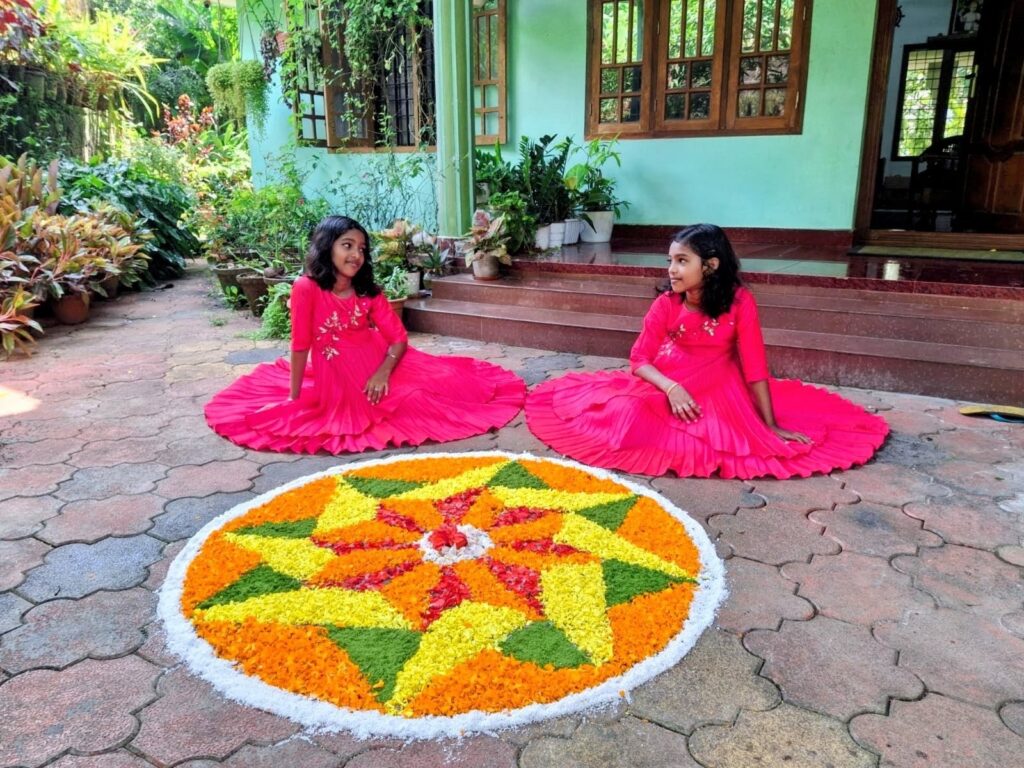
Intricate floral carpets created using fresh flowers.
Traditional vegetarian banquet served on banana leaves.
Traditional snake boat races.
Tiger dance with performers painted as tigers.
Classical women's group dance.
Masked folk dance.
Traditional games played during Onam.
Grand cultural procession marking the beginning of celebrations.
Clay representation of Vamana or Mahabali installed during the festival.
Traditional Foods
Rice
Sambar
Parippu
Avial
Olan
Kaalan
Erissery
Pachadi
Kichadi
Thoran
Injipuli
Pappadam
Banana Chips
Sharkara Upperi
Pickles
Rasam
Moru
Payasam varieties
A traditional Onasadya may include more than 20 dishes served on a banana leaf. [2]
Cultural Importance
Equality
Prosperity
Hospitality
Gratitude
Family unity
Community harmony
Agricultural abundance
Cultural identity of Kerala
Geographic Distribution
Primary:
Kerala
Widely Celebrated By:
Malayali communities across India
Gulf countries
United States
Canada
United Kingdom
Australia
Singapore
Malaysia
Associated Art Forms
Kathakali
Mohiniyattam
Thiruvathirakali
Pulikali
Kummattikali
Chenda Melam
Panchavadyam
Traditional Attire
Mundu
Kasavu Mundu
Jubba
Kasavu Saree
Kasavu Set Mundu
Economic Importance
Major retail season in Kerala
Increased agricultural trade
Tourism growth
Handloom and textile sales
Flower market expansion
Hospitality industry growth
Traditional arts and crafts promotion [1]
Interesting Facts
Celebrated by Malayalis irrespective of religion as a shared cultural festival.
One of India's largest regional festivals.
The floral carpet (Pookkalam) grows larger each day during the festival.
Onasadya is among the world's largest traditional vegetarian festive meals. [3]
References
Works cited in this article.